Diversity in field engineering – Allyship – a practical and positive compass

Last Updated on 23 February 2026 by Tim Robertson
An Update in 2026
Since writing about Allyship for The Field Engineer, Gordon has continued to work, mentor, volunteer and raise money for charitable causes.
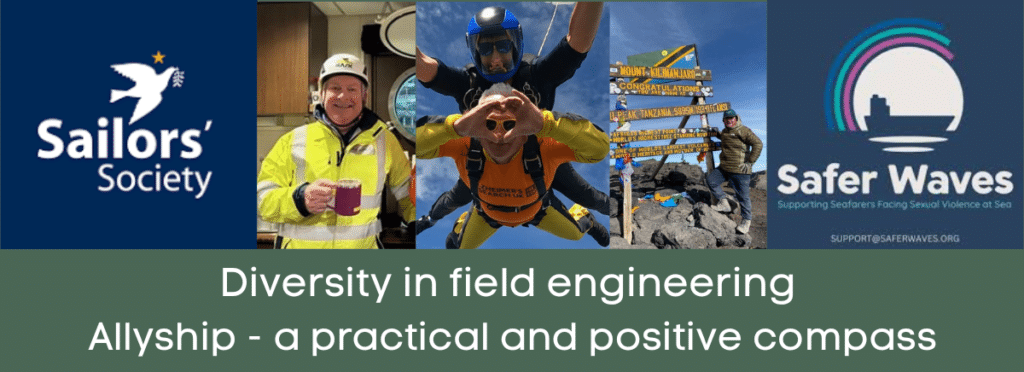
After this article, later in 2023 Gordon summited Mt Kilimanjaro at 5896m and raised £13,500 for the charities Sailors’ Society and Safer Waves.
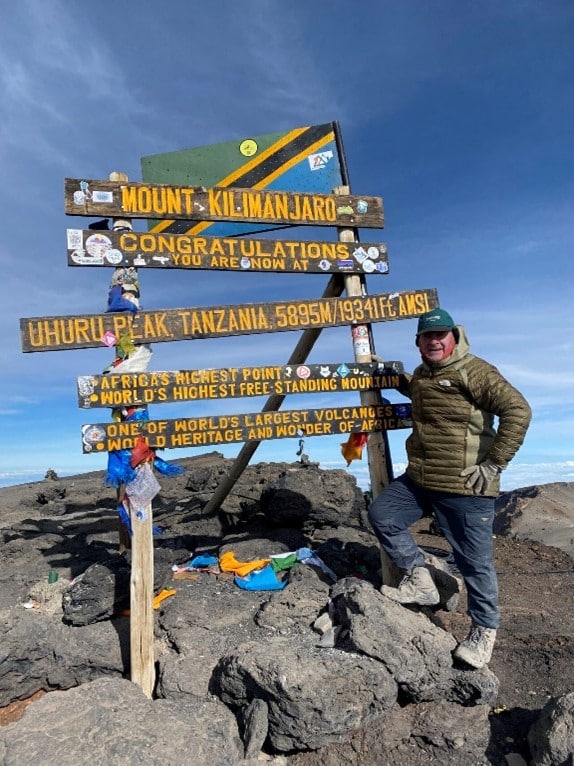
Gordon believes that as a professional we have a duty to ‘pay it forward’ and give back’ to our industry and disciplines and use our passion to encourage others to do likewise. What better Ally could that be?
By consideration to others and doing some good in the world you can promote the very ethos of allyship and being the best human being that you can etc. Gordon does this annually via his social media ‘Inspiring the Maritime’ on LinkedIn.com where he showcases people and organisations that support doing some good in the world. Being self-funded on such challenges ensures that all the money raised goes to the charities.
Mentoring and Inspiring
Gordon continues to mentor students from many different places including:
University of Plymouth
Plymouth YMCA
MLA College.
He works with different organisations including:
Careers at Sea
STEM Ambassadors
Inspiring the Future
The Nautical Institute and IMarEST career programs.
Fundraising
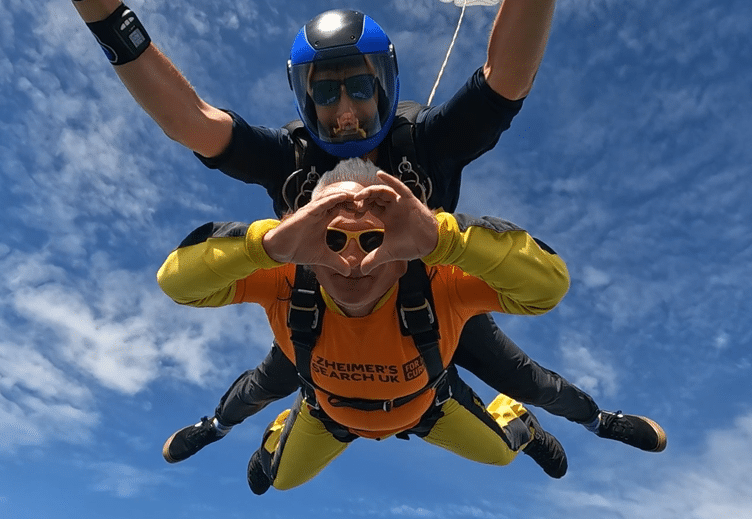
In 2024 Gordon undertook some 10k road races and then completed a 15,000ft skydive for Alzheimer’s Research UK raising £6,000.
In 2025 it was the Costa Rica coast to coast challenge. Travelling by human power (trek, mountain bike, kayak and raft) from the Pacific Ocean to the Caribbean Sea and crossing the continental divide promoting sustainability and raising £17,000 for charity.
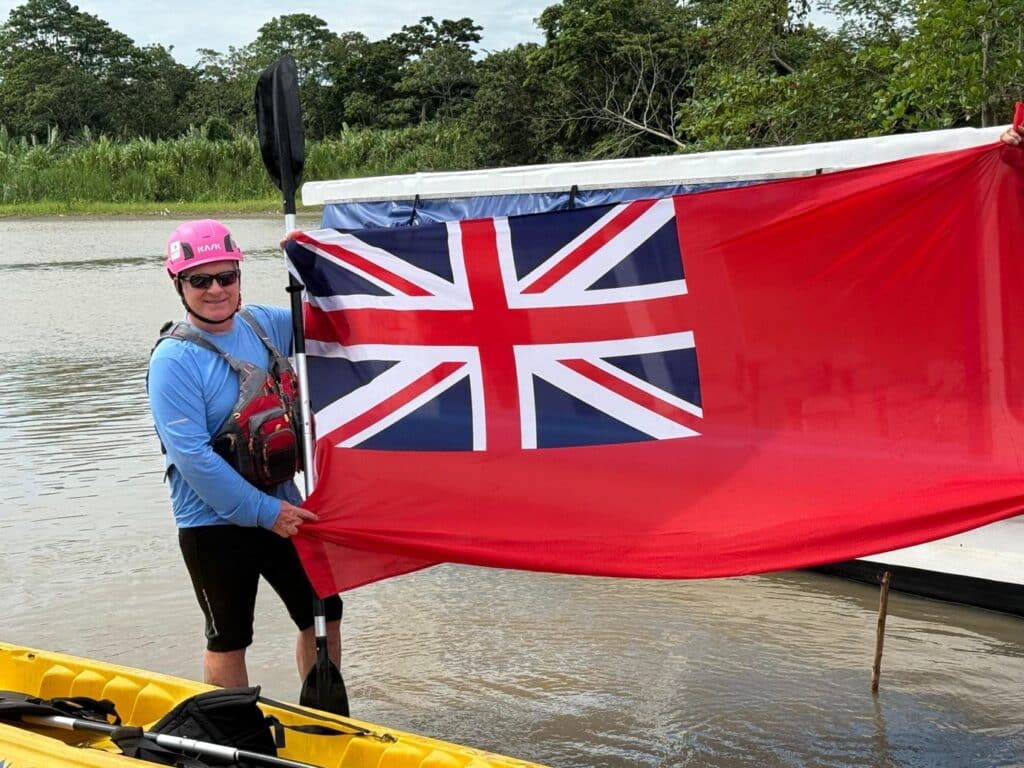
For 2026 Gordon has chosen the Nordic Challenge 2026, trekking in Lapland from Abisko, Sweden to Narvik, Norway from mountain hut to mountain hut over a week to raise awareness of homelessness whilst supporting the Queen Victoria Seafarers Rest. QVSR have been providing shelter for homeless seafarers, veterans and others since 1843 !! They also run all the seafarers ‘missions’ that provide welfare and respite services in ports.
Gordon Foot
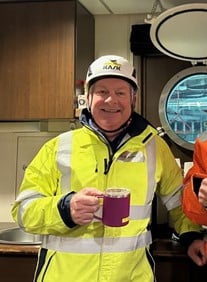
Gordon Foot is a consultant and operates in a shipborne senior leadership role as a Senior Client Representative supervising offshore operations on major offshore wind farms, oil and gas, and environmental projects. Recent projects include offshore wind farms in the North Sea for TenneT TSO GmbH and offshore construction for BP in Senegal and Mauritania. In this article he discusses allyship to increase diversity in field engineering.
Strategies for practising Allyship to increase Inclusion

Background
Gordon is a retired Weapons Engineering Manager of the UK’s Royal Navy having served a 19-year career in nuclear submarines on special operations.
Gordon is a husband, father, and grandfather as well as a mentor and volunteer for many people and organisations including:
Mentoring at sea
Women in maritime careers
STEM Maritime UK
Maritime careers ambassador to schools (‘Inspiring the Future’ programme)
https://www.royalnavy.mod.uk/
Gordon has shared his experience and techniques for building and maintaining strong, successful and diverse teams.

Field Engineers
Being a field engineer takes a special kind of person. A field engineer is required to think more holistically about their trade and the environment that they work in and on occasion provide the client with something that is bespoke. Their trade skills are required to be more agile and adaptable. Their environment can be strange for the most part and completely alien at the extremes. As engineers out in the field, we can adapt, provide solutions, and support each other and the project aims.
What is a field engineer?
‘Field’ tends to lend to the idea that we are discussing being on terra firma (dry land). Whereas in fact for a great many engineers working in the field this could not be further from the reality. There are many who work at sea, in the air, or underground.
Working on or below the sea
My discipline has provided me a career that has been solely maritime, either on or below the oceans. This has involved experiences across submarines, oil and gas platforms, offshore wind turbines, and removal of plastics from the Pacific. However, primarily it’s been all about ships and maritime.
One of the skills this has taught me is how to use psychology to nurture interpersonal relationships within small high-performance teams that are built on trust.
A new term that I have found useful is Allyship.
What is an “ally” in the context of Allyship?
An ally is someone who identifies as being from a “non-marginalised” group who uses their perceived “privileged position” to advocate and support a perceived “marginalised group”.
For example, men are usually the majority within all types of engineering whereas women engineers are often a very small percentage, and trans or bisexual engineers are an even smaller percentage. So men could be seen as a non-marginalised group and women/trans/bisexual as marginalised groups.
What does an Ally do to practise allyship and increase diversity?
To be an ally you need to think about how you would react in a situation. Then practice what you might say and do, and then be ready to actually say or do it.
For example, if you observe a woman engineer explaining something and being ignored, you could support the validity of what she is saying.
In short it means supporting your colleagues. Yes, it involves a consideration for diversity, equity, and inclusion. Yes, it involves understanding yourself, your emotions, and biases, but it is not that complicated. I once described it as a deeper understanding of emotional and cultural intelligence. By this I mean that you are more attuned to empathy, compassion, ethics, and integrity; and how this relates to you as you travel on your life’s journey as an engineer.
In all sincerity I believe it is just really simple.
I believe it is all about being a decent human being.

Communication
I believe it is fundamental to get communication correct the first time. Unambiguous communication in our dynamic, complex, and fast-paced world needs clarity and we humans are not always so good at clarity. What we say and do has consequences, so being respectful to our colleagues is both vital and shows our professionalism.
Whether it is with women or any other marginalised or minority group (this can include age, less experienced, colleagues in unfamiliar surroundings, cultural, or religious) we are, at the point of first impressions, required to be professionals. Taking time in communicating at this point is vital and will lead to stronger relationships and less chance of miscommunication or misunderstandings.
New and less experienced engineers
There are some key circumstances to consider. For example, these include when:
a new colleagues join an established team;
someone less experienced makes an error;
a member of the team raises a question that to us seems obvious.
I am sure once upon a time some of us more senior engineers can remember when we were less experienced, and we wished to be heard and we wished to be treated with respect.
Putting yourself in someone else’s shoes or seeing things from their perspective is not hard to do. For some of us it may need practice. The point of being an ally is that you do just that. You consider others and do what is appropriate, instead of a knee jerk reaction to a situation.
Leading teams
Of the great many leadership traits that abound I have a personal preference for being ethical. This is why my approach is from a humble leadership stance. As an engineer I find that not only do we get the job done, together, but we all get to enjoy the experience. Next time you are ‘out in the field’ maybe you could just take a minute and ask yourself, ‘is my moral compass well adjusted’, ‘am I being an ally?’ I can guarantee you that the team will benefit and as engineers we will all benefit.

Further reading
Further reading about field engineering

Interesting read.