Day in the life of a HealthCare Field Service Engineer

Last Updated on 3 September 2026 by Tim Robertson
What is it like to work as a Healthcare Field Service Engineer? In 2022, Fausto Cruz shared the answer to this based on his experience working as a Healthcare Field Service Engineer for GE Healthcare. Since then Fausto, has continued to develop his skills as a Healthcare Field Service Engineer and has completed a degree in Computer Engineering.
Working as a Healthcare Field Service Engineer in 2026
An Update in 2026
Changes in Healthcare Field Service
Working as a Healthcare Field Service Engineer, what changes have you seen in equipment and medical field service in the last 3.5 years? Any predictions for the future?
In the last 3.5 years, we have seen big changes in medical equipment and in the way field service is done. In the past, we worked mostly with analogue systems. Today, the machines are digital, connected, and much smarter. This evolution brings better accuracy in diagnosis and clearer system logs. In some cases, the system can already show the symptoms and even suggest which parts we need to replace.
However, the role of the Field Service Engineer is still essential. Technology can point out possible problems, but the engineer needs to interpret the logs, verify the information, and apply safe solutions. The machines are “talking” more, but they still need trained eyes and ears to turn data into safe actions.
Another big change is Artificial Intelligence in Healthcare. Companies like GE HealthCare are already using FDA-approved AI solutions, especially for medical image post-processing. This helps doctors make faster and better clinical decisions. For us in the field, it means we work in a more complex environment, where understanding software and algorithms is just as important as knowing physical hardware.
Looking to the future, AI is growing very fast. I believe equipment will become more autonomous, finding errors and suggesting preventive maintenance. It will be like a patient saying:
“I have this symptom. Please replace this part soon.”
Our challenge will be to keep our critical thinking to adapt solutions for patients and hospitals, not just follow automated steps.
In short, field service in healthcare is changing from reactive to predictive and smart. The future will need more technical knowledge, analysis skills, and teamwork, especially in IT. Technology is evolving, but the field engineer is the human link that makes everything work safely and effectively.
Travel as a Healthcare Field Service Engineer
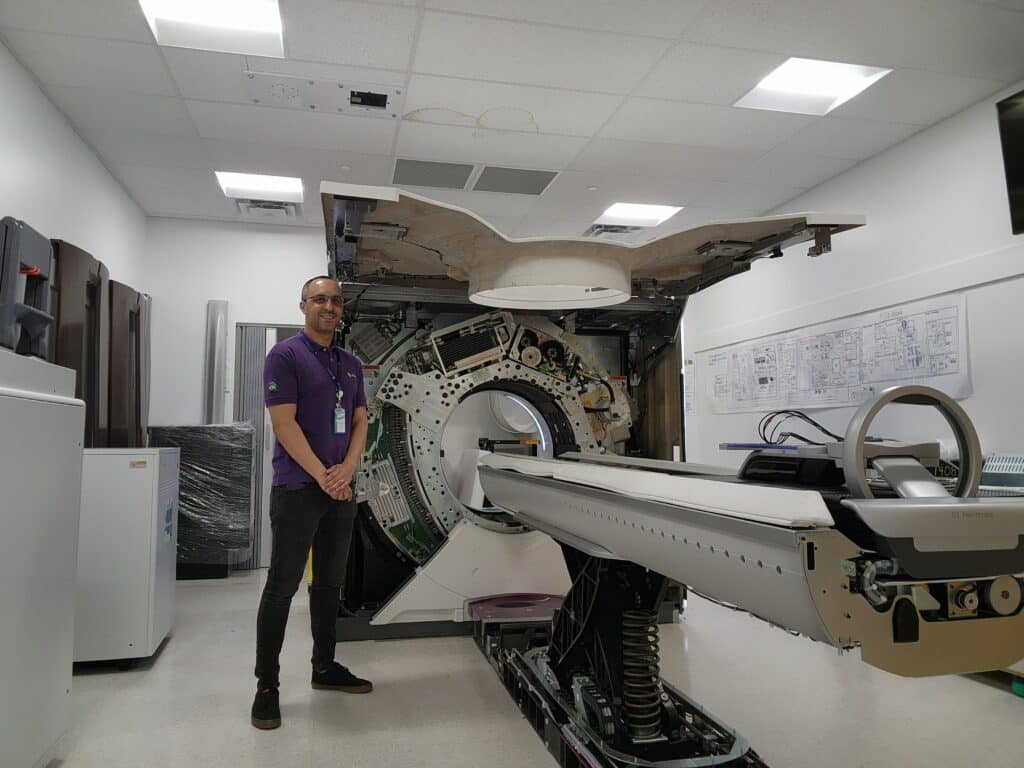
Like a lot of Brazilians, you spend a lot of time in your car travelling to work and to customers. What do you do to make the time productive and more interesting?
In big Brazilian cities like São Paulo and Rio de Janeiro, traffic is a real challenge every day. In São Paulo, it is normal to spend about 1 hour and 30 minutes or more to travel 35 to 45 km during rush hour. Sometimes, a short distance of 5 km can take more than 20 minutes in busy areas. I often think that running would be faster than driving! It takes a lot of our time and energy.
Working as a Field Engineer at GE HealthCare, I learned to use this challenge as an opportunity. Because I work with about six different equipment modalities, I can balance on-site visits and remote tasks. During heavy traffic hours, I focus on remote activities: global meetings, customer projects, or helping colleagues with technical support. This strategy helps me save time and reduce stress.
When I have to visit multiple customers in one day, I plan a smart route. I start with the customer furthest away and travel back towards my home, visiting other sites along the way. But as an FSE, we know that unexpected things happen and can change our plans completely.
I care a lot about time, even though I cannot control it. I plan my day carefully: what problem was reported, what troubleshooting is needed, and how much time I have. I am a big fan of the movie The Equalizer (with Denzel Washington), where the main character counts every second before taking action. I try to do the same: I never enter a hospital without checking technical documents, planning the steps, or talking to an experienced colleague first. Preparing everything before going to the field saves time and makes my work much more effective.
Work Life Balance
You have a son, Eduardo. How do you balance working and family life? What advice can you give to other Field Service Engineers about balancing family and the work they do?
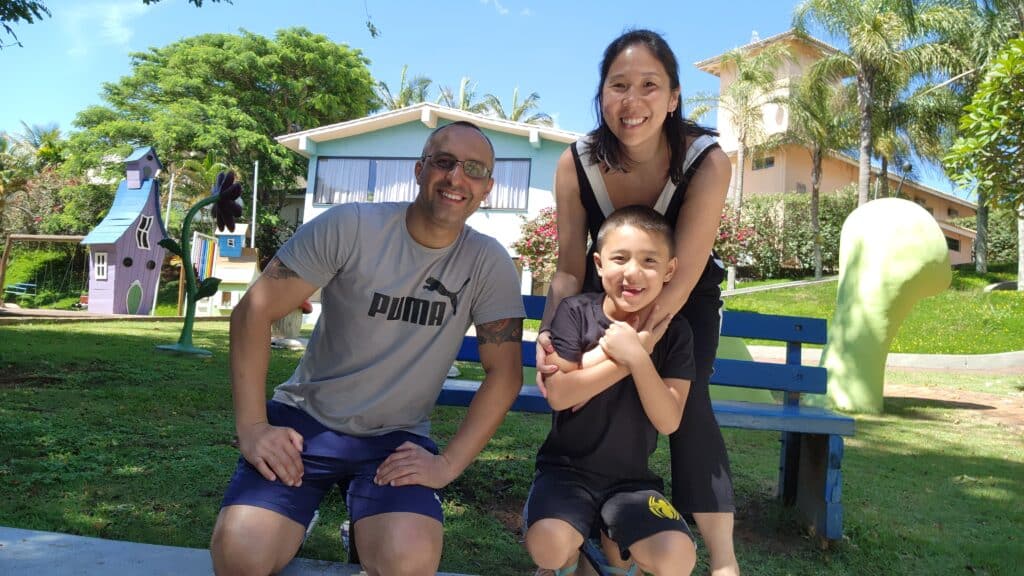
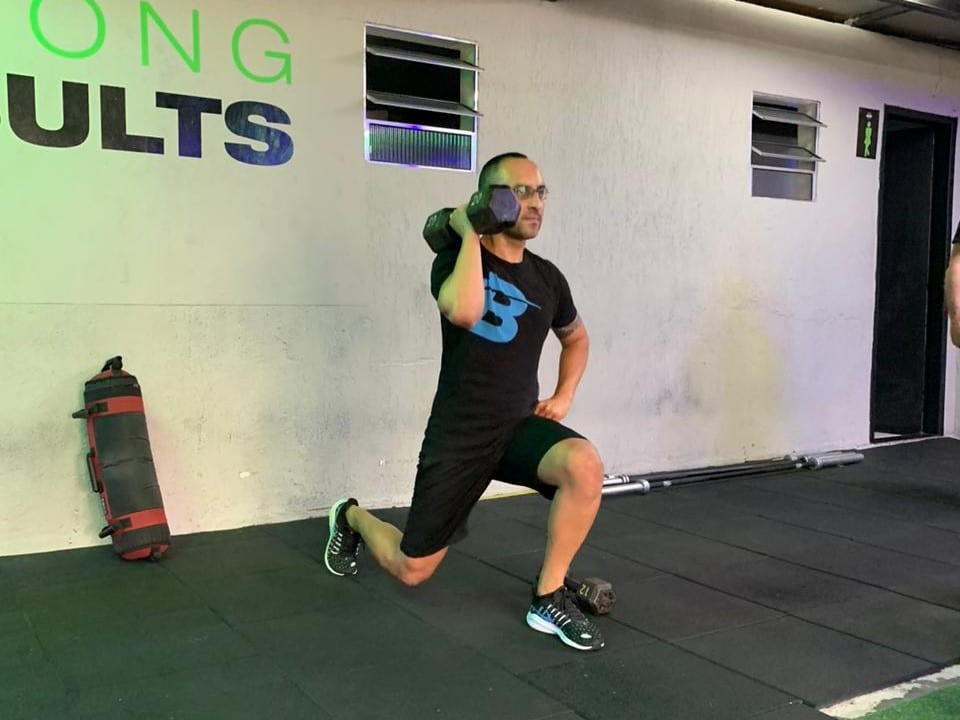
Balancing the busy routine of field engineering with family life is not easy; it is a daily exercise of priorities and self-knowledge. My wife is a senior nurse and leader at Hospital Sírio-Libanês, so we both understand demanding jobs. But when our son, Eduardo, was born, everything changed. Being a present father and husband became my biggest priority.
Today, family is the foundation of everything. If my home is not well, my work cannot be well either. That is why I plan my family time like a critical SLA (Service Level Agreement) as follows.
The “Discipline of Presence”
Monday to Friday, I take and pick up my son at school and go with him to his Parkour Kids classes, while my wife and I manage our workouts and commitments. Saturdays are for Eduardo’s swimming classes and free time. Sundays are for church, visiting our parents, and family time (unless I have an urgent preventive maintenance).
The Notification Shadow
We live in a world of constant messages. Having a separate work phone is very important for me. When I am off work, I simply turn off my corporate phone. I know myself: if it stays on and I see someone asking for help, I will stop everything to help them. So, turning it off is the best way to protect my quality time with my family.
My advice to colleagues is: you are unique and irreplaceable at home and in your child’s life. At work, you are a great professional who should be supported by a good team and system. Treat your family with the same dedication you put into troubleshooting. They are the foundation that never fails when you keep them first.
The Future
Looking to the future, what do you want to do next in your career?
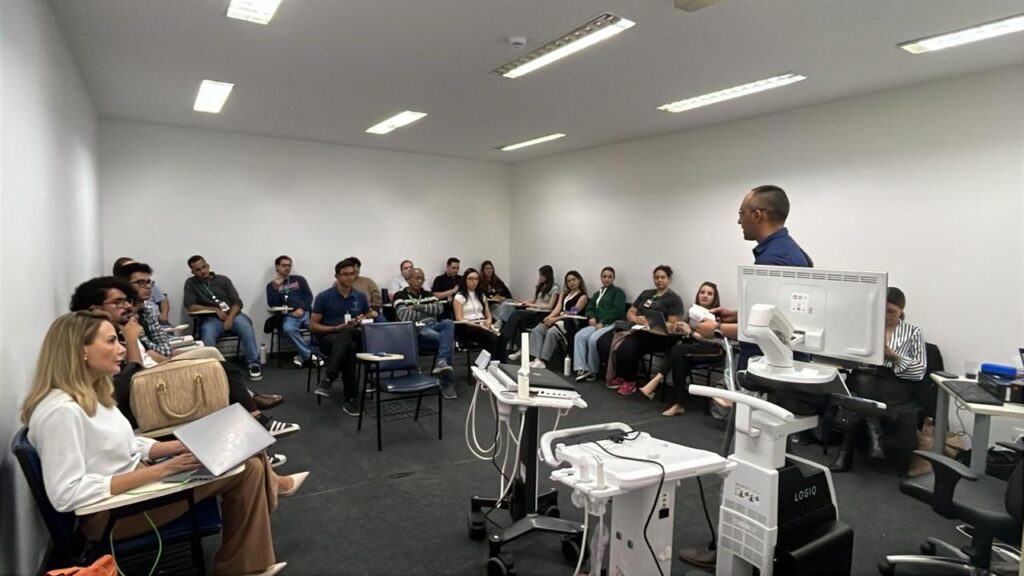
Because I like working with others, learning constantly, and solving hard problems, I see my future moving naturally to two areas: Advanced Support and, later, Technical Trainer. I have received offers to work in sales and product management, but my real passion is purely technical. This is where I see myself, because it matches my personality and what I already enjoy doing.
I really like working on complex cases, solving tough technical problems, and then teaching what I learned to other colleagues. This cycle of learn–solve–teach is what motivates me and connects with my future goals of training new engineers.
In summary, my goal is to continue growing beyond Level 1, gaining more advanced experience, and sharing knowledge to help develop the Field Engineering community in Healthcare.
Mental Health and Field Engineering
What role does mental health play in the life of a Field Service Engineer?
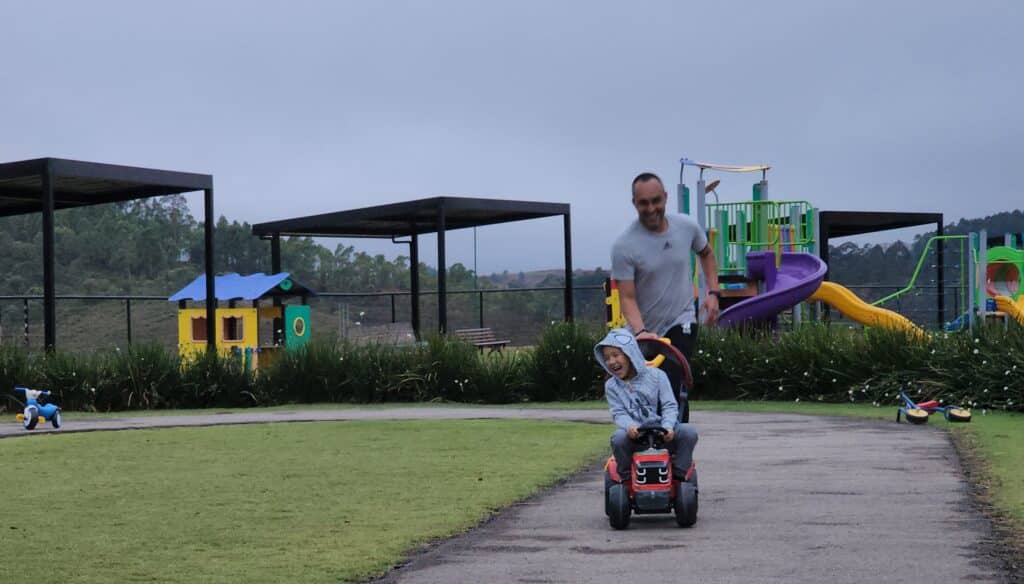
Between 2021 and 2025, I lived the most difficult period of my career. At that time, I thought I had to be “unbreakable,” but extreme exhaustion almost cost me my mental health and my marriage. I thought about giving up many times, feeling that I was not the father I wanted to be. The turning point came when I looked for professional help. I learned an important lesson: if my personal foundation is not solid, professional performance is only a temporary mask.
My advice to other engineers is simple: do not wait until you reach your limit to ask for help. If you feel you are carrying the whole world on your shoulders, talk to someone. Companies value good performance, but the long life of your career and your happiness depend on your mental health.
Accepting our limits does not make us less professional; it makes us human and better prepared for life and work.
Continuous Learning as a Field Service Engineer
How important is continuous learning for a Field Service Engineer in Healthcare?
Continuous learning is an absolute necessity. During my career, I always looked for new knowledge to work faster and with better quality. To show this commitment, during my most demanding period as an FSE, I completed my second degree in Computer Engineering, while studying English and Spanish.
Continuous learning is not just about following new technology; it allows me to share knowledge and help train other engineers. When a field engineer studies continuously, they become a reference and a support for the whole team.
Updating our skills in hardware, software, and now AI is what helps us solve today’s problems and be ready for the medical equipment of tomorrow.
Healthcare Field Service Engineer working across Latin America
How has working with colleagues across Latin America shaped your career?
It has been a truly transformative international experience. Even though my official role is a Level 1 field engineer (focused on on-site service), I never limited myself to only this level. Many times, I help as Level 2 (giving technical support to other field engineers) and even Level 3 (connecting with factory engineers on escalated cases).
Much of this growth came from supporting colleagues in Brazil, across Latin America, and collaborating with expert engineers in Europe on complex topics like image post-processing, systems, applications, servers, and operating systems.
This work requires critical thinking, multitasking, and the ability to help other engineers solve critical issues quickly, while still completing my own tasks. Working across different cultures and technical realities expanded my networking and gave me a global, mature view of field engineering today.
The Original Article
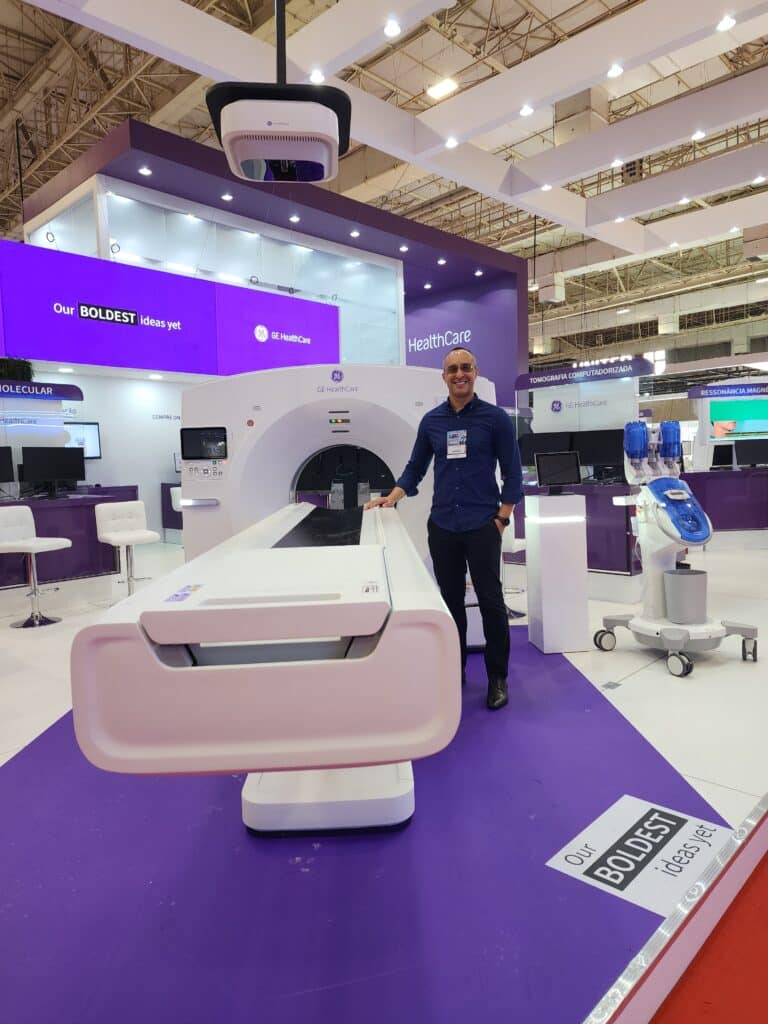
Fausto Cruz is a Healthcare Field Services Engineer with over 15 years of experience in healthcare, currently working at GE HealthCare.
Meet Fausto Cruz GE HealthCare Field Service Engineer from Brazil

Fausto is coming up to six years with GE and in that time has already accumulated more than 24 awards. Three of them are for first, second, and fourth place in gamification against all the field engineers in Brazil.

In addition to working as a field service engineer, Fausto has added EHS (Environment, Health and Safety) inspection to his workload. He has been doing this for the last two years.
As well, he has started to work on the remote connectivity of imaging equipment.
Background before working as a healthcare field service engineer
Where did you work before you moved into healthcare?
I did something completely different. For seven years, I worked in IT, including working for a very well-known investment bank in Brazil.
Were there any childhood interests which were a factor?
When I was a child, I grew up seeing my dad working in industry at night and doing extra work during the day. I usually went to school every morning and after that, I used to go help my dad with his extra jobs. So, from an early age, I learned to work with electrical and hydraulics. So, it was then that my interest in different types of engineering started.
Has there been a particular person who has inspired you?
My dad was the most outstanding example in my life. He was an excellent professional role model working as an electrician. He always received a lot of recognition from his co-workers and customers.
Have you always liked fixing things?
I can remember that I loved playing with my dad’s tools and causing a few short circuits in the electrical outlets in my mother’s house. Also, as a good boy, I always took my toys apart and then put them back together.
In 1998 when I was 15, I got my first computer with Windows 98. The internet could be used with a dial-up connection, and I usually spent a long time surfing the internet even before dawn. This is where my passion for IT was born.
Computers to Biomedical and HealthCare Field Service Engineer
You studied Computing and then worked in IT. How did you crossover into Biomed?
During my studies, I had a network computer course that I loved. The main reason for that was because of the fantastic teacher – Vladimir. He was demanding and very intelligent. So, I fell in love with network computers and when I completed high school, I decided to start studying Computer Networking Technology at Universidade Cruzeiro do Sul.
After I graduated, I started Computer Network Management at FIAP (Faculdade de Informática e Administração Paulista),one of the greatest IT universities in São Paulo.
I used my studies and worked in IT for a long time. For part of the time I worked for one of the biggest Brazilian investment banks, called Banco Itaú BBA. It was an immeasurable opportunity, where I could learn a lot about the latest technologies of that time. Also, I was able to develop many of the skills which still help me.
Which skills did you take with you?
Programming logic is by far the best skill that I learned in IT. I use it all the time to understand each problem at my customers’ sites. Programming logic helped me to have an open mind and see many possibilities at a critical moment, so I use it in my professional and personal life.
Studying and starting in Biomed
You’ve kept on studying – how have you balanced this with working in a demanding job?
In 1999, I started studying Mechatronics which led in 2000, to the opportunity to start my professional career working with biomedical equipment.
Where did you work to start your biomedical career?
My first job was as an intern working with Baxter 1550 hemodialysis equipment at Clínica São Jorge, now NephroCare.
Two years after that I started a new role at a military Hospital, called Hospital Cruz Azul, working with new Baxter Tina hemodialysis equipment as well. At this time, I had a lot of direct contact with dialysis patients. Seeing the weekly struggle of each one of them during the period I worked in each of the clinics made me really understand the importance of my work.
Typical day as a HealthCare Field Service Engineer
What’s your typical day like?
Every day is busy but organised.
I start my day by waking up early (around 05:30 am) to get my son ready for school, while my wife gets ready to go to work.
At 06:00 am they leave home together, and I go to the gym, spending about an hour doing my workout. Next, I return home to take a shower and breakfast.
Then, I leave my home to visit my first customer and the first case of the day. The number of cases each day, depends on their complexity. But I usually work on two or three cases a day (there are some days that I work on four or five cases). Sometimes, before work, I take my son to school or pick him up when I finish my day.

I’m currently doing a new degree, studying the fifth semester of Computer Engineering at Centro Univesitário Eniac, and my classes start at 6 in the evening. So, I need to be very organised in my daily activities to be able to arrive on time at university.
Finally, I return home to play with my son for a while, before he goes to sleep. After that I do some homework and then go to sleep ready to start again the next day.
How much of your time is spent ‘hands-on’ and how much helping your team?
I would say that I spend most of my time working because when I’m not with a customer on-site, I’m working at home or on my mobile helping someone. I’m the sort of person who loves to help others. It’s a real pleasure to do this!
Support in the workplace
Which other people in the workplace give you support?
I’m very blessed to know many people who have supported me in the past and who support me today. I can name a few people who have given me great examples of hard and soft skills that I have learnt. In fact, I could mention many, many names, but I will just give a few special people here.
Eduardo Fujita and Fabrizio Rodrigues since the beginning of my career as a GE HealthCare channel partner. They provided me with the many different types of assistance and direction to be who I am at GE.
Alex Toledo my old Area Service Manager, is a very clever person who can work with all sorts of people. He always helped me to understand what I was struggling with.
Carlos Varela, Sérgio Rocha, Claúdio Corrêa, Mauricio Vidal, and Tales Souza are giants of support in their respective areas. They are always available to help anyone with their knowledge.

Alejandro Cortez is the best-ever official instructor in MICT. I have good memories and good times with him getting a lot of different instructions about CT scans. I felt he was betting on me. Above all, a great friend!

Erick Fiori, Cesar Velicka, Júlio Gomes, André Uriel, Ricardo Cruz and Gustavo França my best friends and co-workers help me all the time with different questions, professional or personal.

Building relationships with customers as a HealthCare Field Service Engineer
How do you start to build a relationship with a new customer?
Working as a field engineer in healthcare, we often go to a clinic or hospital to solve critical problems. In my opinion, the first thing to do is to truly listen and understand the customer.
How do you develop the relationship so that it becomes more than just ‘supplier’ and ‘customer’?
I’m the typical person who has “owner pain”. That means that although the machines are not mine, in every technical service I feel as if they were mine. I cannot leave the customer’s site until I’m sure that I cannot do anything more. So, I hope that my customers understand my true dedication and it builds a very good relationship.
Another thing that is very crucial for me is, to be honest with my customers and to tell them the truth about their equipment. It doesn’t matter if I have good or bad news. I always need to be honest, so that makes us more than “supplier” and “customer”.
Equipment used as a HealthCare Field Service Engineer
What are the types of equipment you work on?
Nowadays I work with:
All types of GE HealthCare Ultrasounds
Bone and Metabolic Health Systems
CT Scanners
Workstations for Ultrasounds
Dexa Scans (bone density)
CT Scans.
Furthermore, I’m also learning about PET/CT.
What is the best piece of equipment you have ever worked on?
It’s not an easy question for me, because every new thing I do is exciting at the early stage. So, each piece of equipment is the best.
What has been the most difficult piece of equipment you have worked on?
I think that all equipment is not easy to work with when you are starting on something new. There will always be a new challenge when you are doing something for the first time. We all feel fear, but if we believe in ourselves, we will be able to do it.

Most challenging part of the job
What do you find most challenging when you are working – technical side or people/customers?
Both, sometimes, are big challenges.
Machines cannot say anything. We need to read their logfiles to interpret them and understand the machine’s symptoms.
On the other hand, people are easier to understand. But sometimes they don’t want to be understood.
Most challenging job to date
What has been your most challenging job to date?
I’ve had many challenging situations in my professional life. Usually, they all relate to people who have a difficult temperament or strong opinions.
But there is a case that has stuck in my memory. In this case a doctor located in a region where I don’t work, had a problem with his relatively new equipment, after a few months of use. Another field engineer was working on the issue alongside a regional support engineer. After some unsuccessful attempts at repair, they called me asking for my support since I had much more experience in the equipment model in question.
When I was there at the clinic, I asked the doctor to try to reproduce the problem so that I could see and understand completely. Once I could see the issue, I asked him to give me a few hours to work on the problem. So, I started removing all the boards from the equipment to get all the hardware identifications (serial number, part number, codes, versions, revisions, etc). As I collected this data, I cleaned the boards and reinstalled them again. When the customer saw me doing that he said:
“What you are doing, the other engineers have already done that, and it didn’t work.”
So, I kept working and replied:
“I think it will work now!”
After reinstalling all the boards, I turned on the equipment, accessed a specific area of the system, revalidated, and corrected the entire hardware inventory and, after that, rebooted the system. Once that was done, the equipment never presented the same defect again.
Easy fixes
Have you ever arrived on-site and found that it’s been much easier than you expected? For example, have you just needed to switch on a machine?
Oh yeah! I have already had a lot of cases where, just after I arrived, the machines started to work well.
Some customers say:
“You have holy hands.”

Teams
How do you motivate your team?
Being a team player, working and learning together. When we work as a team, we feel more confident and able to improve ourselves.

What are your tips for the best ways to share knowledge and experience with other engineers?
I usually say to my “young” classmates: it’s not enough to be the best in your technical work if you are not able to understand the business of the company whose equipment you are working on. It’s necessary to understand how important it is that all departments work together like clock gears. Building relationships with the more diverse areas inside of the company can help you learn and teach more than you can imagine. Here I’m talking about building not just technical skills, but commercial, financial, and many other skills.
How do you support someone in your team when things have gone wrong because of a mistake?
I am a people person and feel happy when anybody requests help from me. I often stop my work to help those who request my help. If I’m not able to answer a question, it’s a good opportunity to learn something new.
“Your doubt can be my doubt.”
Making a future star
Apart from a strong technical background, what are the three most important skills to have?
IT Knowledge
Nowadays, where so many things are based on technology, I would say that IT knowledge is essential so that you can learn much more fluidly.
People skills
Be a friendly person, always able to work in a team, because then you will learn faster and do better.
Understand the whole organisation
As mentioned in a previous part, understanding completely the business of the company you work for and, more than that, understanding your customers.

Further reading
Other biomedical engineers share their knowledge and experience.



Responses