
The Communication Gap Costing Healthcare Millions in Downtime

Last Updated on 14 August 2026 by Tim Robertson
This healthcare article combines real-world biomedical field service experience with workflow discovery questions to help identify operational inefficiencies, communication gaps, and opportunities for workflow optimization within healthcare equipment service operations. The responses are based on direct experience working with OEM and third-party imaging systems across hospitals, clinics, and healthcare facilities.
Biomedical Workflow Discovery Responses & Industry Insights in Healthcare
Section 1 — Background Information
Current Role & Responsibilities
I have worked as a biomedical and imaging field service engineer supporting OEM and third-party contracts involving GE, Hologic, Siemens, and Steris systems. My responsibilities include preventive maintenance, troubleshooting, system calibration, quality assurance testing, electrical diagnostics, customer communication, documentation, and emergency response support for imaging and patient care equipment.
Types of Healthcare Equipment Serviced
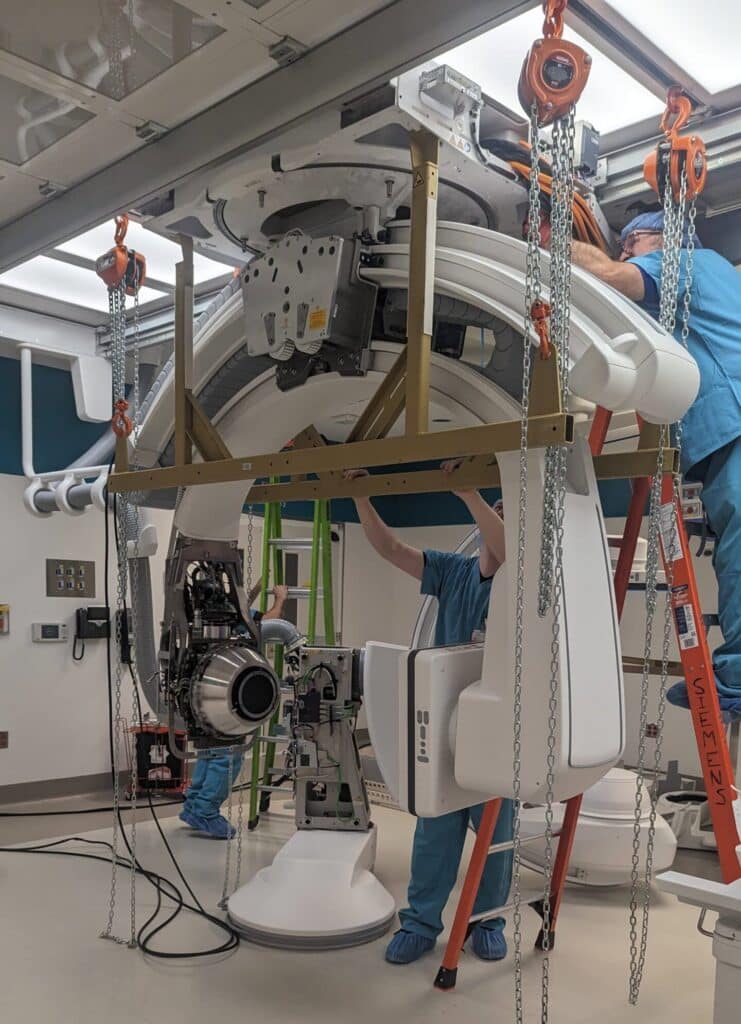
Equipment experience includes GE Lunar Prodigy/iDEXA systems, Hologic Horizon DXA systems, Siemens CT and MRI platforms, Artis angiography systems, Mobilett X-ray systems, Steris sterilizers, surgical tables, infusion pumps, ECG systems, and patient support devices.
Typical Weekly Workload
Weekly workloads often involve multiple preventive maintenance visits, emergency service calls, travel across Washington, Oregon, and Idaho, remote troubleshooting, and coordination with hospital staff, dispatch teams, and OEM support.
Service Structure
Experience includes working with OEM service teams, third-party service providers, and hospital biomedical departments. This exposure provided insight into how communication flows differently depending on the service model.

Section 2 — Current Workflow in Healthcare
Issue Reporting Process
Most service requests begin through dispatch systems, emails, phone calls, or internal hospital ticketing systems. Information often passes through several departments before reaching the field engineer.
Communication Flow
The engineer may receive information from dispatch coordinators, imaging managers, technologists, biomedical departments, and OEM technical support before arriving onsite.
Software & Ticketing Tools
Common systems used include Siemens eVO, CB Docs, SKB systems, TMS platforms, and internal documentation tools for PM reporting and service management.
Communication Breakdowns
Communication commonly breaks down due to incomplete symptom descriptions, delayed escalation, lack of standardized intake questions, missing environmental data, and multiple layers of relayed information.
Section 3 — Communication Problems in Healthcare
Missing Information
The most commonly missing information includes exact error codes, environmental conditions, patient throughput impact, intermittent fault behavior, prior troubleshooting attempts, and whether the issue is software, electrical, or mechanical.
Inaccurate Descriptions
Symptom descriptions are frequently generalized by non-technical staff, requiring engineers to spend additional time onsite verifying issues.
Multi-Department Delays
Delays commonly occur because information is relayed differently between radiology staff, biomedical departments, dispatch coordinators, and OEM support channels.
Need for Clarification
Field engineers often need to call back multiple times before dispatch to clarify symptoms, operational conditions, and urgency.
Largest Troubleshooting Delays
The biggest delays occur when engineers arrive onsite without proper operational context, parts history, or system telemetry.
Section 4 — Operational Inefficiencies in Healthcare
Causes of Repeat Visits
Repeat visits are often caused by incomplete diagnostics before dispatch, incorrect part ordering, unavailable calibrated tools, or lack of historical service visibility.
Sources of Downtime
Unnecessary downtime occurs when communication delays prevent rapid diagnosis or when environmental issues are discovered only after arrival onsite.
Administrative Burdens
Documentation, manual scheduling coordination, follow-up communication, and fragmented ticket systems consume significant time.
Workflow Bottlenecks
One of the largest workflow bottlenecks is fragmented communication between hospitals, dispatch teams, OEMs, and engineers.
Section 5 — Existing Software & Data
Current Systems
Current systems are often fragmented across scheduling software, documentation systems, OEM portals, and internal communication platforms.
Integration Issues
Most systems are not fully integrated, forcing engineers to gather information from multiple sources before troubleshooting.
Desired Dashboard Features
An ideal centralized dashboard would include service history, alarm history, environmental readings, live telemetry, prior repairs, customer observations, and AI-assisted troubleshooting recommendations.
Pre-Arrival Diagnostic Data
Before arriving onsite, engineers would benefit from access to equipment telemetry, system logs, environmental data, calibration history, and standardized symptom reporting.
Section 6 — AI & Automation Opportunities
AI Ticket Summaries
AI-generated ticket summaries could reduce information overload and help engineers prioritize critical details before dispatch.
Automated Intake Questions
Standardized intake workflows could dramatically improve troubleshooting accuracy by ensuring key information is collected early.
Predictive Maintenance
Predictive maintenance alerts could reduce downtime by identifying failure trends before systems become non-operational.
Voice-to-Ticket Automation
Voice-to-ticket transcription could help clinical staff quickly report issues without interrupting patient workflow.
Automation Priorities
The highest-value automation opportunities include service triage, historical case retrieval, intelligent part recommendations, and pre-dispatch summaries.
Section 7 — MVP Validation Questions
Most Important Problem to Solve
The first workflow issue a software platform should solve is the lack of structured communication and operational context before dispatch.
Immediate High-Value Feature
A unified pre-dispatch intelligence dashboard would provide immediate value by reducing uncertainty before onsite troubleshooting.
Trust & Adoption Factors
Adoption would increase if the platform integrated seamlessly with existing workflows and clearly reduces downtime and repeat visits.
Implementation Concerns
Potential concerns include data privacy, integration complexity, training requirements, and resistance to workflow changes.
Pilot Program Interest
Many departments would likely pilot workflow optimization tools if they demonstrated measurable improvements in response time and equipment up time.
Real-World Operational Example
Severity 1 Water Damage Incident
During a preventive maintenance visit on a dual-energy X-ray absorptiometry (DXA) scanner
system, an urgent severity 1 service call was received involving another dual-energy X-ray absorptiometry (DXA) scanner from a different manufacturer, that was experiencing water damage. The system had been powered down due to risk of electrical short circuits. After coordinating with facility maintenance teams, inspecting for moisture intrusion, consulting OEM documentation, and ensuring safe environmental conditions, the system was stabilized and returned to operation without disrupting hospital workflow. This situation highlighted how critical real-time communication, environmental visibility, and rapid coordination are critical in healthcare service operations.
Future Vision for Workflow Optimization
Industry Direction
The future of biomedical field service is moving toward predictive and intelligence-assisted workflows. The next evolution of service operations will combine engineer expertise with live telemetry, AI-assisted diagnostics, operational dashboards, and centralized communication platforms.
Core Philosophy
Software should not replace engineers – it should accelerate their ability to make faster, safer, and more informed decisions in mission-critical healthcare environments.
These findings reinforce a recurring theme across biomedical and imaging service operations: many delays are not caused by the repair itself, but by fragmented communication and lack of structured operational visibility before dispatch. Addressing these workflow inefficiencies creates significant opportunities for healthcare-focused software platforms.
Dan Galiant

As an imaging field service engineer, I have worked with integrated computer systems (ICS) that support medical imaging by managing data acquisition, image processing, and secure communication across hospital networks. My experience includes network configuration, IT troubleshooting, and system integration across multiple imaging modalities. These systems handle data acquisition, image processing, and data management, ensuring the seamless integration of imaging devices, patient data, and hospital information systems. My expertise includes mechanical repair, IT troubleshooting, quality control, inventory management, and efficient workflow efficiently to support high-quality diagnostic imaging and patient care. Coursework completed in biomedical circuits and signals, biomechanics and biomaterials, cardiovascular mechanics, and biomedical chemical principles. Leadership experiences and involvement developed time management skills and adaptability.

Join the discussion – networking groups for members of our community working in Healthcare Technology
https://thefieldengineer.com/groups/biomeds-biomedical-engineers-and-technicians/
https://thefieldengineer.com/groups/biomedical-and-laboratory-equipment
Some Healthcare discussions on our Podcast
Richard Baker MIET discusses his career in healthcare technology and Radiotherapy LINACs
Roundtable Discussing Service Revenue, Contracts, and SLAs





Responses