
An engineering journey makes a marriage on the Mercy Ships


Last Updated on 4 February 2026 by Tim Robertson
What is it like to volunteer in field engineering on the Mercy Ships? Deborah Geneugelijk and Corné Geneugelijk are working in field engineering by volunteering on Mercy Ships. Deborah joined from Ghana and Corné from The Netherlands. They are now married and ready to embark on the next stage of their journey in The Netherlands as a couple.
Great life volunteering as field engineers on Mercy Ships
Deborah Geneugelijk
Background
Why did you decide to study Biomedical/Medical Engineering?
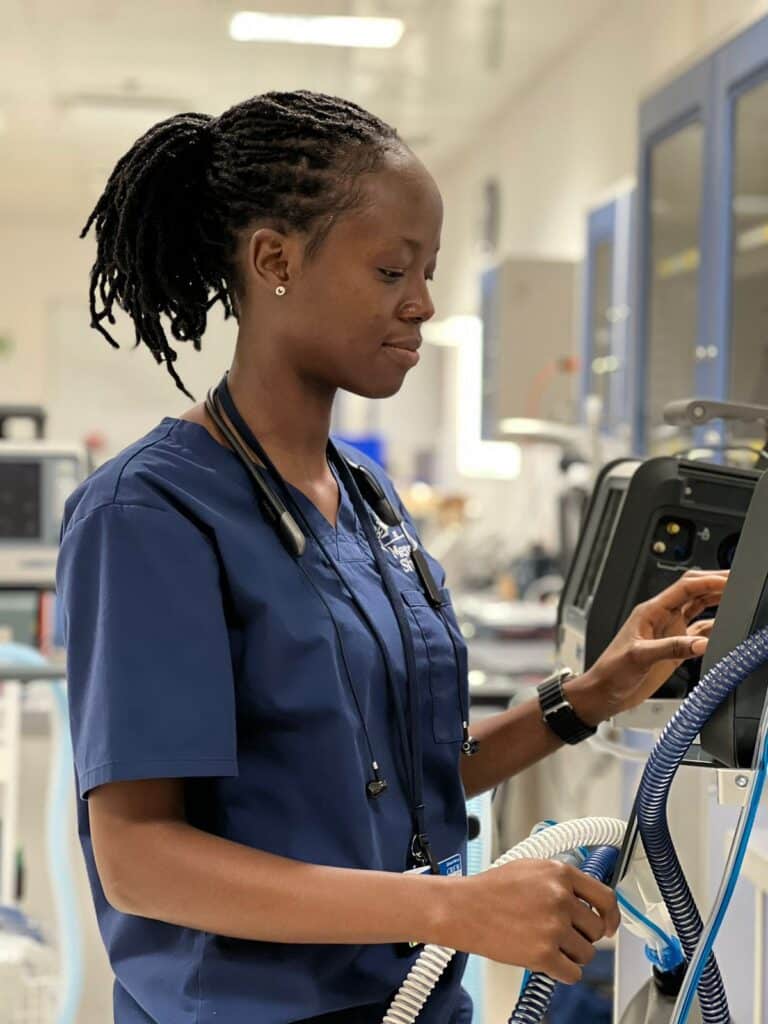
Before I studied Biomedical/Medical Engineering, I was interested in being in the health sector to help save lives directly. But I also watched and helped my uncle who is a Mechanical Technician to fix things in our house like our generator, the blender, the iron, his car and other things. So, I started to grow my love for fixing items.
Why did biomedical engineering attract you rather than another type of engineering?
Biomedical Engineering was the programme I found in university that allowed me to combine the two things I loved, healthcare and engineering.
Was working to help other people a factor in your decision?
Yes, I wanted to do work that can directly impact and save people’s lives.

Types of equipment
What types of equipment have you worked on in your career so far?
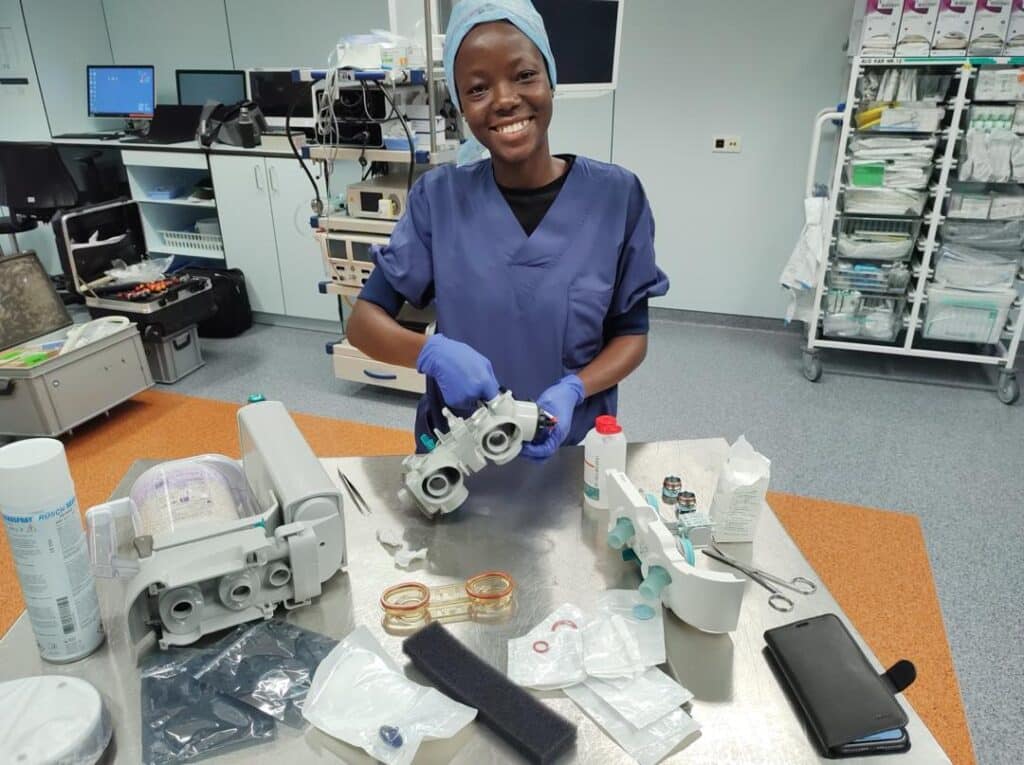
In the 6 years of my career, I have worked on a lot of equipment. A few of them are:
Radiology Equipment (like CT Scanners, X-ray and Mobile X-Ray machines, Cone Beam CT, OPG machines and dental X-Rays, Ultrasound machines, C-Arms),
Operating Room equipment like, Anaesthesia machines, Electro Surgical Machines, OR Table, etc.
Ventilators,
Patient Monitors,
Infusion devices,
Suction devices,
Eye equipment,
Dental Equipment,
Lab Equipment,
Hospital furniture,
Thermometers,
Washers and Sterilizers,
And many other things.
Which has been the most interesting?
Honestly, they are all equally interesting because I learn new things and ways to create solutions. Because I also have special training with some Radiology Equipment, I especially love working on them.

Current work as a Biomedical Technician on Mercy Ships
You have been working as a Biomedical Technician on Mercy Ships since April 2022. What exactly does your role involve?
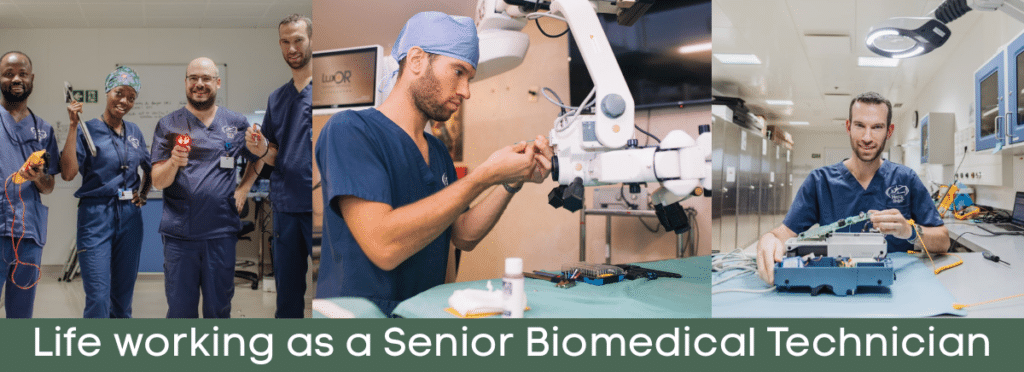
We are a full hospital going from port-to-port country after country. Because of this, we have no dependence on shore Biomeds to help to maintain our equipment on Mercy Ships. So, we Biomeds onboard do all the maintenance ourselves for all our 2200+ pieces of equipment from CT scanner to thermometers and everything in between.
What new skills have you learnt in this time at Mercy Ships – hard and soft?
Being at Mercy Ships has taught me a lot. Woking with different cultures has helped me appreciate differences between individuals and opinions. I have also learned more about compassion and giving back and helping people in need. I also learned some baking skills and of course Dutch language.
Hospitals and medical facilities can be places where there is a lot of pressure on staff. How do you handle things when people are very stressed?
At Mercy Ships we do not have an emergency or accident centre which means we don’t get to certain levels of pressure. However, emergencies on board do happen and can be unpredictable. We have weekly drills which we take seriously. Our team on Mercy Ships practices weekly what we need to do in any emergency. This helps in actual emergencies as everybody knows what to do and so not to panic. Also, because of my experience with our equipment and procedures, when users are stressed, which does not happen too often, it is easy to help.

Volunteering and sharing skills
Why would you recommend volunteering to other medical engineers and technicians?
In Mercy Ships, I get to be a part of the work, the hope and healing. I get to see the use of the equipment I maintain and appreciate the value of my work. As a Biomedical Technician in Mercy Ships, your work has great purpose and value, and you see it in real time, and everybody seems to be extremely grateful.
New medical and biomedical engineers
What sort of personality traits and skills are ideal to be a medical engineer?
Compassion.
You must have patient safety at the heart of your work.
Controlled curiosity, willingness to learn, resilience.
You should do your work knowing that the next life your equipment will save may be yours.
How do you think medical and biomedical engineers differ from other engineers?
Patient safety is behind the work of a medical or biomedical engineer. Because the equipment touches patients directly, medical and biomedical engineers are very precise and must make it safe.
What advice would you give to someone who is thinking of a career as a medical engineer?
It is a very broad career, and you cannot get bored. You will learn a lot and help a lot.
The future
What are your hopes for the next stage of your career after Mercy Ships?
I hope to continue to work helping others and I hope for a platform to actively share my skills with others.
Corné Geneugelijk
Background

Why did you decide to study Mechanical Engineering? Was your childhood on a vessel part of this decision?
Growing up on an inland vessel I saw a lot of technology around me. My father was the Captain, Sailor, Engineer, Motorman, and fitter of his own 73m 970-ton ship (good for around 35 trucks). I didn’t know it back then, but my technical skill “common sense” was built by watching and learning it from my dad and things around me.
We were regularly in the biggest ports of Europe (for example, Rotterdam). Goods were transported directly from sea ships into our ship by the biggest cranes available. In smaller ports I was allowed off ship and allowed to accompany the workers loading/unloading the ship – for example, shovel drivers, truckdrivers and crane machinists. To be a kid in this kind of industry environment, it was normal to me, now I can see it was not usual at all.
Even though it is tough, it is a good life to work on inland vessels. When the time comes to go to school you have to go to boarding school. Luckly for me I only needed to go for 4 months because my father sold the ship. But as siblings we knew, do not get into shipping because it means you need to send your children to boarding school.

In high school, while studying English, I saw a picture with the word factory.
In this picture there was a line with cars and welding robots were welding the cars.
That image (quite sure it is this one or very similar) I kept with me and it was what I wanted to do. Programming these robots and making a production line.

Why did mechanical engineering attract you rather than another type of engineering?
As I wanted to work with robots, I looked into what I needed to take to get there. There wasn’t an exact programme of studies that would do this. So, I looked at both mechanical and electrical engineering. Both had some robotics. The reason I chose mechanical is that when I design a system, I can hold it in my hand physically. Also, I am a visual thinker, in my mind I can see designs as you have it in a 3D program like SolidWorks. While I was studying, a nearby university introduced a programme for mechatronics. That would have been the perfect fit for me.
Did you want to work at sea? If so, what attracted you to this?
Even though I grew up on a ship and have a shipping family, I didn’t want to get involved in shipping. Also, I like the Netherlands and like to stay where everything is known. Things changed when I was looking online to see what I could do for developing nations from home. (There are some NGOs developing products for the African market like Buffalo bicycles.)
I already knew Mercy Ships and came across their website again and eventually learned that they would be coming to Antwerp with their new ship. They were looking for technical skilled handy people to outfit the ship. Antwerp is only a few kilometres/miles from the Dutch border, so sure I could go for a month.
Over there I heard the stories from the volunteers that had gone to Africa with Mercy Ships. Initially, I didn’t want to go to uncertain times and places but then heard the calling. So, a year later I boarded the MS Global Mercy for the second time, and I’ve now been onboard for three and a half years.
Types of work, tools and equipment
What types of tools and equipment have you worked on in your career so far?
Some cobots (collaborative robots), and some CNC machines. However, most of all a big 174m hospital ship which is a small village with capacity to host 600 crew, 200 patients as well as 200 day crew at any given time.
Current work as a Plumber (Mechanical Engineer) on Mercy Ships
You have been working as a Plumber on Mercy Ships since September 2022. What exactly does your role involve?
Mercy Ships operate two hospital ships across the African continent. We provide free healthcare for those who can’t afford it themselves. The field service time is around 10 months a year and then 2 months for sailing, maintenance and yearly certifications.
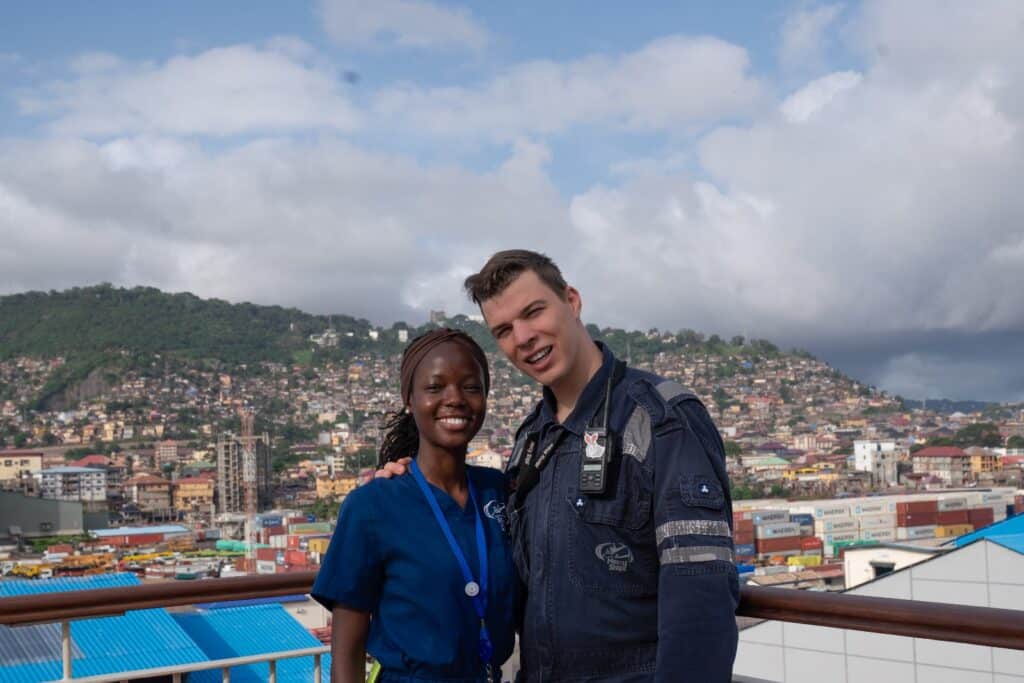
I am enlisted on the Global Mercy currently located in Sierra Leone. The Global Mercy is the world’s largest civilian hospital ship, 174m length, 37,000 gross tons, 12 decks, 6 operating rooms, 200 patient beds, facilities for 600 volunteer crew and 250 day crew.
With our plumbing team we take care that everything keeps flowing where it is supposed to flow. This means fixing leaks and blockages on our fresh, technical, grey and black water systems. Summarised it looks like a small and easy job, but to think that this means to maintain around 750 taps, 400 toilets and 350 showers, it gives a clearer picture. Everyday there is at least something blocked, especially with our patients that come from places where flowing water or proper sanitation doesn’t exist.
What new skills have you learnt in this time – hard and soft?
When I say plumbing team, I mean 3 crew and 3 dayworkers. The dayworkers are from the country we work in. The 2 other plumbers are volunteers coming from countries like Senegal, Switzerland, Norway, Philippines, Pakistan, UK, and Lebanon.
As previously, I have done plumbing only as a Saturday job under direct supervision of a 45-year-old experienced boss I didn’t need to think things out, just do it. Now I first needed to learn to grow as a plumber, then to learn to give instructions to my day crew. After a year I was the longest serving around (as some plumbers serve as short as 2 months) and stepped up my game. Bit by bit I let the new plumbers do the short-term jobs, for example, a blockage here a leak there. Then I focussed on the long term, like planning new pipelines, major repairs, ordering spare parts, organising the workshop and overseeing the team.
The biggest skills I have learned and am still learning are as follows.
1. Clear communication
Because we are from so many different backgrounds we tend to communicate differently. We are trying to work in a closed loop communication to see if we have understood each other. It still happens that I have worked with someone for a long time and think now we are on each other’s wavelength, so I instruct something quickly and they totally misunderstand me.
2. Timely ordering systems for spare parts
It takes at least 4 months to get our spare parts in. So, it is essential to order the right parts. If you do not put in the right description or someone made a mistake, you wait for 9 months to get the parts in. But be aware, it is a ship, so space is limited, stock taking is essential to not run out.
3. Working with vacuum systems
Like the toilet in the airplane, we have a vacuum system on board for our toilets. It is like compressed air but then reversed, so you need to think about it “reversed” to fix the components of a vacuum system.
4. Learning to drive a car in Africa
Learning to drive a car in Africa was very different and a bonus.
Handling pressure
How do you handle things when there is a big issue and people are very stressed?
Sometimes we have big leakages/floods. The best way to handle this is to be prepared. At the end of the workday keep tools organised in your tool bag, have spares that can fix a leakage the “dirty” way (e.g. bicycles innertubes) and have the emergency vacuum cleaners on standby.
In this way, if the pager goes in the middle of the night and you are half asleep, everything is ready for you to grab and do your job.
Volunteering
Why would you recommend volunteering to other engineers and technicians?
Volunteering is all about giving something without expecting to get something back. But man, you do get more out of it than you give. No, not in money but in gratitude and purpose. You don’t have to go to Africa to do this, start small and serve with your hands the people around you. Especially the people that cannot afford you, then you receive something that money can’t buy.
The future
What are your hopes for the next stage of your career?
It has been four and a half years since I have graduated. As I have always dreamt of working with robots, I applied to a robot company (Valk Welding in Alblasserdam in the Netherlands) this summer. I am happy that I have been hired and will start work from mid-February 2026 as a Junior Product Engineer.
I hope to grow more experienced in the EU and maybe in the future to (help) start a company for myself or a western mechanical engineering company in west Africa.
Deborah and Corné
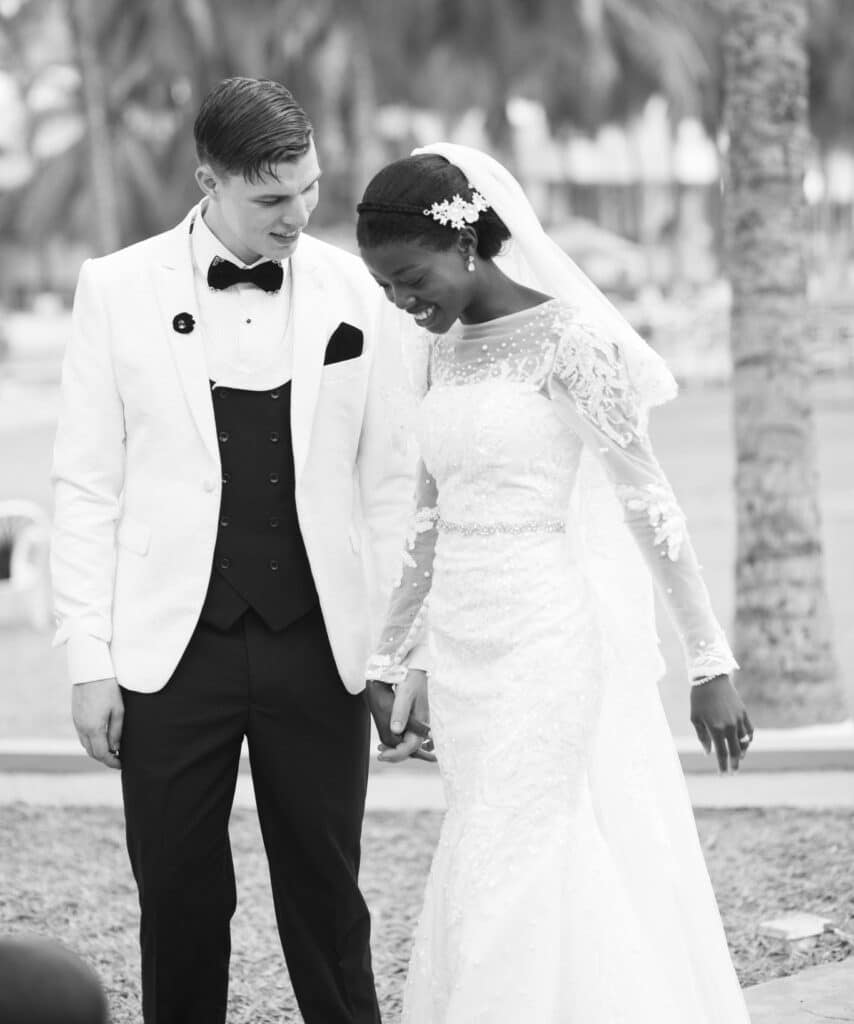
You have both contributed your time and expertise to Mercy Ships since 2022 and are now leaving for the next stage of your careers. You are leaving the ships with many things including new friends and new skills, but most importantly with each other. What are your thoughts at the beginning of 2026?
We are extremely grateful to God for how we have grown both individually and together. We also feel privileged for these past four years in our lives to be able to do voluntary work and help people alongside our community. We are preparing for the next steps in our journey, leaving the ship and we look forward to whatever opportunities are ahead of us.
What is it like to be a married couple on board a ship?
As the famous African saying says:
“If you want to go fast, go alone. If you want to go far, go together”.
It is a blessing that we both may serve God with our gifts as engineers on the ship.
Further reading
Who repairs and services Africa’s medical equipment?
Successful life of a Hospital Ship Biomedical Engineer

I love this, how paths of passion lead to blessings. If I had known of biomedical engineering and Mercy Ships when I was single, I think that is where I would like to be. Thank you for sharing your stories, and for what you do every day. Your work is important.