
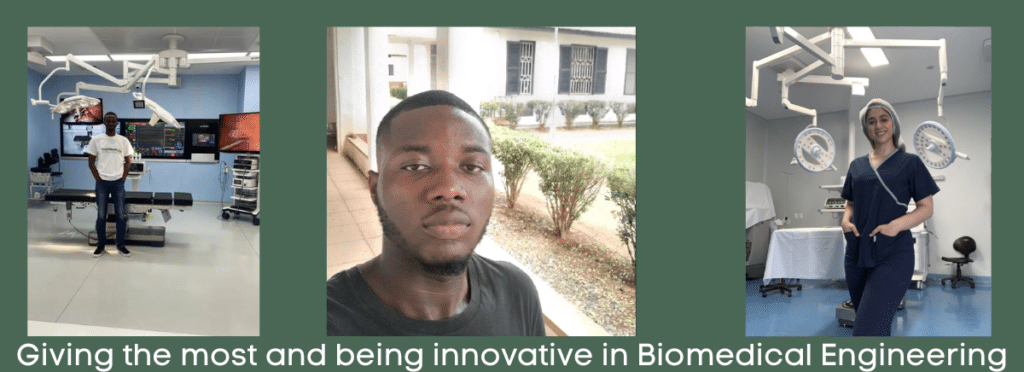
Giving the most and being innovative in Biomedical Engineering

Last Updated on 20 January 2026 by Tim Robertson
What is it like to study and start a career in Biomedical Engineering? How is AI influencing the field of biomedical engineering in universities and in the workplace? Obed Kofi Didiblah has a BSc in Biomedical engineering from the University of Ghana. He has interests in the future of biomedical engineering and how AI will impact it.
Working in Biomedical Engineering – one man’s exciting story
Background

Have you always liked fixing things? And helping people? Can you give examples?
Yes, I’ve always enjoyed understanding how things work and finding ways to make them better.
As a kid, I used to open up old gadgets at home just to see what was inside.
Later, during my internship at the 37 Military Hospital, I got to repair and maintain medical devices with my team. Seeing those machines working again and knowing it would help patients made me realise I wanted to keep doing work that makes a real difference.
Was there a particular person at school or in your family who inspired you to study in biomedical engineering?
Yes. My uncle, who worked as a technician, really inspired me. He used to fix medical and electronic equipment, and I was always curious about what he did. Watching him solve problems so calmly made me want to understand technology at a deeper level.
Were there any childhood interests which were a factor in you becoming an engineer? Can you give examples?
Definitely. I loved science and building things when I was younger. I would spend hours playing with broken electronics, connecting wires, and experimenting with batteries and bulbs. That curiosity for how systems work eventually led me to engineering.
Who are some famous engineers or scientists that you admire?
I admire Elon Musk for his drive to innovate across industries, and Professor Sam Kojo Kwofie, my department head, for his work in bioinformatics and in biomedical engineering research. Both show how science and engineering can transform lives when applied with purpose.
Why study in biomedical engineering
Why would you suggest studying in biomedical engineering or medical engineering to other people who are deciding which branch of engineering to study?
I’d suggest it because it gives you the chance to solve problems that truly matter. You get to design and improve medical devices, develop diagnostic tools, or even use AI to detect diseases early.
In biomedical engineering you find a branch of engineering where engineering meets compassion.
If someone is at school now, what could they do to start to prepare for studying biomedical engineering?
Focus on science subjects like physics, biology, and mathematics. Also, stay curious by exploring how technology is used in medicine, watch videos on medical innovations, or try simple DIY projects that involve electronics or coding.
These little steps help build a strong foundation.
Why in your opinion is it a good career?
It’s a good career because it’s meaningful. You’re not just working with machines; you’re improving the quality of life for people. Biomedical engineers bridge the gap between healthcare and technology, and that’s something the world will always need.
What sort of personality traits are ideal for becoming a biomedical engineer?
Curiosity, patience, creativity, and empathy.
You need curiosity to explore new ideas, patience to troubleshoot, creativity to design better solutions, and empathy to understand the human impact of your work.
Technology in Biomedical Engineering
How do you think that AI is going to help and change biomedical engineering?
AI is already reshaping biomedical engineering. It helps doctors analyse medical images faster, predict diseases earlier, and personalise treatment. For engineers, AI allows us to design smarter devices and improve diagnostic accuracy. I’m particularly excited about how AI can make healthcare more accessible and affordable in places like Africa.
Internships
You completed internships while studying. Why do you think internships are a good idea?
Internships are one of the best ways to connect what you learn in class with real-world practice. They help you understand how the systems you study actually function in hospitals or labs and give you confidence when handling equipment or solving problems.
What did you learn from your internships? (hard and soft skills)
At WACCBIP (West African Centre for Cell Biology of Infectious Pathogens), I learned how to use Python and R to build machine learning models for classifying medical images, and I also worked on computational drug discovery.
At 37 Military Hospital, I gained hands-on experience repairing, maintaining, and installing medical devices.
Beyond the technical skills, I learned teamwork, communication, and the importance of staying calm under pressure.
The future in Biomedical Engineering
What are you goals and ambitions for your future career?
My goal is to contribute to building smarter and more affordable healthcare systems using AI and innovative medical devices. I want to create solutions that make diagnosis and treatment faster and more accessible, especially in underserved areas.
Would you consider working in another country? And why?
Yes, I would. Working abroad would allow me to gain new perspectives, experience advanced technologies, and collaborate with experts.
I’d love to bring that knowledge back to Ghana and use it to improve healthcare locally.
Is there an area of biomedical engineering you would like to specialise in?
Yes. I’m most interested in medical devices and AI for healthcare innovation. I want to focus on developing devices that can improve diagnosis, monitoring, and treatment, making healthcare more efficient and accessible for everyone.
The future in Biomedical Engineering in Africa
What are your hopes for the future of biomedical engineering in Africa?
I hope to see more investment in local biomedical innovation and manufacturing. Africa has brilliant minds, and with the right support, we can design our own medical devices, improve hospital systems, and make healthcare more affordable.
I also hope to see stronger collaboration between engineers, doctors, and researchers across the continent.
Further reading about African Engineers in Biomedical Engineering
Who repairs and services Africa’s medical equipment?
Unique Contributions of Women in Medical Physics and Biomedical Engineering
Life of a Biomedical Engineer in Canada
Ruth Otieno – Philips Field Service Engineer in Kenya
Join
Join The Field Engineer community to network with 100’s of Biomedical Engineers in our ‘Biomeds – Biomedical Engineers and Technicians,’ networking group, and also in our ‘our ‘Medical, pharmaceuticals, life science, bioscience’ Industry Sector networking group.






Biomedical engineering is a life-changing field, and AI has come to stay indeed.